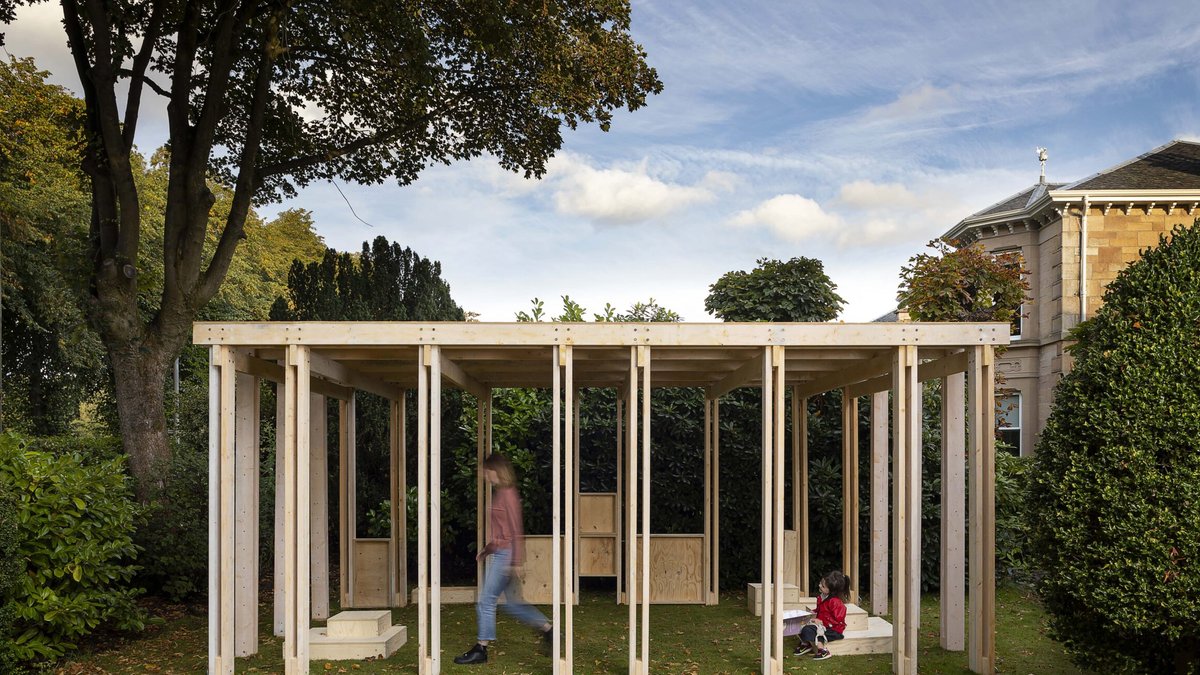
Glasgow-based architecture firm O’DonnellBrown focuses on adaptive reuse projects that balance preservation with community needs, converting vacant or historic structures into functional public spaces. The studio specializes in projects ranging from small outdoor classrooms to large-scale masterplans, prioritizing design that serves local residents over pure aesthetics. According to Jennifer O’Donnell, the firm’s co-director, the goal is to give public assets a viable future, particularly when they have been taken on by charitable organizations.
The firm’s 2019 Community Classroom project served as a prototype for affordable, adaptable infrastructure. Originally built outside their studio, the structure was a self-initiated design using only three lengths of timber. It featured a waterproof fabric covering that allowed users to open and close sides as needed. This approach has influenced other projects, including an in-progress, off-grid learning facility for Edinburgh University.
A similar philosophy drives the recent renovation of the Take a Bow Opportunity Centre in Kilmarnock. O’DonnellBrown converted a poorly insulated, damp, and asbestos-ridden 1970s building into a performing arts center. The team opened the front elevation with larger windows, moved the parking lot to the back to create public space, and added a modest extension for a changing area. O’DonnellBrown collaborated with Carbon Futures to reduce the building’s energy and carbon emissions by 70 percent.
Building on this, the firm recently completed the Millport Town Hall on the Island of Cumbrae. A six-year project, it involved a local group that submitted over 140 funding applications to secure the necessary capital. The completed building now houses a performance hall, spaces for local clubs, and three apartments. These units provide rental income to help cover the venue’s operating costs, ensuring the building remains financially sustainable.
Outside Glasgow, the practice has tackled various types of adaptive reuse. In 2023, O’DonnellBrown retrofitted New Olympia House, a former Salvation Army Citadel from 1927. The project involved a “defurb” strategy that improved energy efficiency and accessibility while exposing brickwork and roof trusses. The firm is also currently converting the 1870s Pipe Factory in Glasgow’s East End into office and educational spaces for an arts organization.
Related: Key Insights from METROPOLIS Summit at Neocon
Conservation as a default strategy
The architects emphasize that conservation and retrofitting are not separate disciplines. Jennifer O’Donnell is working toward accreditation as a conservation architect and argues that a conservation approach should be the default. She notes that the same principles—repairing before replacing, retaining embodied carbon, and designing for reversibility—apply to both heritage sites and modern energy upgrades.
One of the firm’s largest undertakings is the Govan Graving Docks site on the south side of Glasgow. The 22-acre historic shipbuilding site has been vacant since the late 1980s and has seen several failed planning applications. The current masterplan includes a riverside park, 304 homes, a trail, and historic ship repair facilities. The firm spent nearly three years holding workshops with over 20 local organizations to align the project with community needs.
Designing for energy efficiency often requires creative solutions, especially in heritage settings where materials must be preserved. For example, a quiet cooling solution might be integrated into a historic facade without compromising its character. Such strategies ensure that modern comfort needs are met without destroying the historical fabric of a building.
Ultimately, the philosophy extends beyond individual buildings to entire districts. The firm is applying these same principles to the revitalization of the Govan Graving Docks, a site that has been empty since the late 1980s. The masterplan includes a riverside park, 304 homes, a trail, and historic ship repair facilities. O’DonnellBrown spent nearly three years holding workshops with over 20 local organizations to align the project with community needs.
Conservation is treated as the primary strategy.