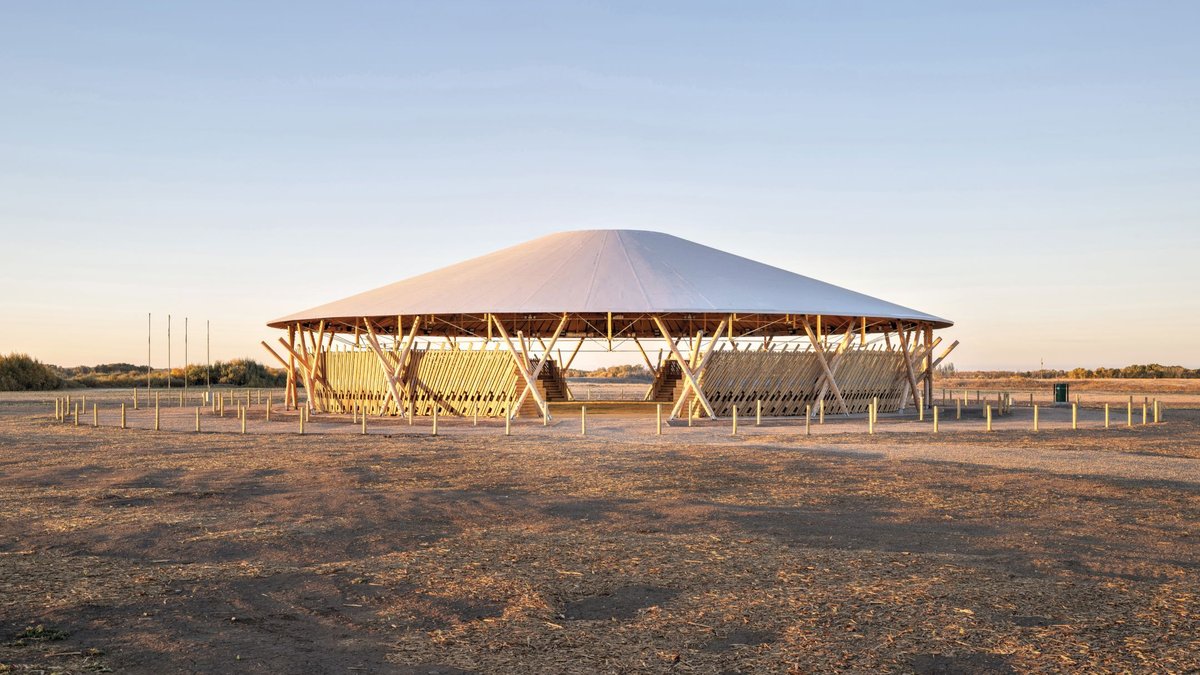
The Muscowpetung Saulteaux First Nation in Saskatchewan has completed a permanent powwow arbour that its leaders hope will help revive traditions suppressed for generations. The structure, designed by Oxbow Architecture in collaboration with Dalhousie University professor emeritus Richard Kroeker, opened last year and hosted its first major gathering in August 2025.
Building a gathering place
Local Indigenous leader and knowledge keeper Jeff Cappo guided the project through years of consultation with community members. Pickard described him as an artist, craftsman, and most importantly, a powwow dancer and event emcee. These conversations revealed what elders required: a building that echoed a traditional Saulteaux lodge, constructed from local materials, with a roof spanning most of the open-air space.
The resulting structure is a large circular timber building. Its roof covers 52,743 square feet, while the gathering space inside measures roughly 13,725 square feet. The architects used Douglas fir and spruce from Saskatchewan, along with nail-laminated timber panels. Cables support the roof, working in a way Pickard compared to the tension in a drawn bowstring or drumhead.
Related: Michael Ford, Momentum Unveil Fresh Hip-Hop Expression
Rainwater collected from the roof will irrigate an adjacent medicine garden and orchard. The building also incorporates renewable energy technologies, though the filing does not specify what kind.
Wisdom in the design
Pickard recounted how Mi’kmaw elder and woodworker Peter Poulet once told Kroeker that sawing a tree was like running a saw diagonally through a rope and expecting it to hold. This observation pushed the design team to prioritize round timber with continuous fibers intact, using the material in its strongest natural state rather than processing it into dimensional lumber.
The structure avoids the need for a center pole, which traditional Saulteaux lodges do not feature. Instead, the circular design and cable system distribute loads while reinforcing the cultural symbolism of the circle in Indigenous practice.
A history of suppression
The arbour carries added weight given Canada’s colonial past. The Indian Act of 1876 prohibited Indigenous people from holding ceremonies including powwows, and from wearing traditional attire. The ban remained in effect until 1951. Some communities continued celebrations discreetly, but assimilationist policies led others to abandon gatherings altogether. Several traditions were lost or altered as a result.
Related: Lowe’s Sells Outdoor Power Tools at Up to 42% Off
“For generations, Muscowpetung families have faced systemic discrimination that continues to shape the hardships they endure today,” Pickard said. “This history has contributed to a disproportionately high number of the nation’s children living in care off reserve—but a shift is now underway that focuses on supporting families to heal and stay together.”
Community members have already described the arbour as meaningful, providing a cultural anchor that supports prevention services for children and families. The structure represents an effort to reverse the damage done by decades of suppression, though officials acknowledged that rebuilding what was lost will take time.
The project also aims to support the reservation’s economy beyond its cultural function, though the filing does not detail specific economic plans. The first powwow at the new arbour drew traditional singing, dancing, and drumming to the space last summer.