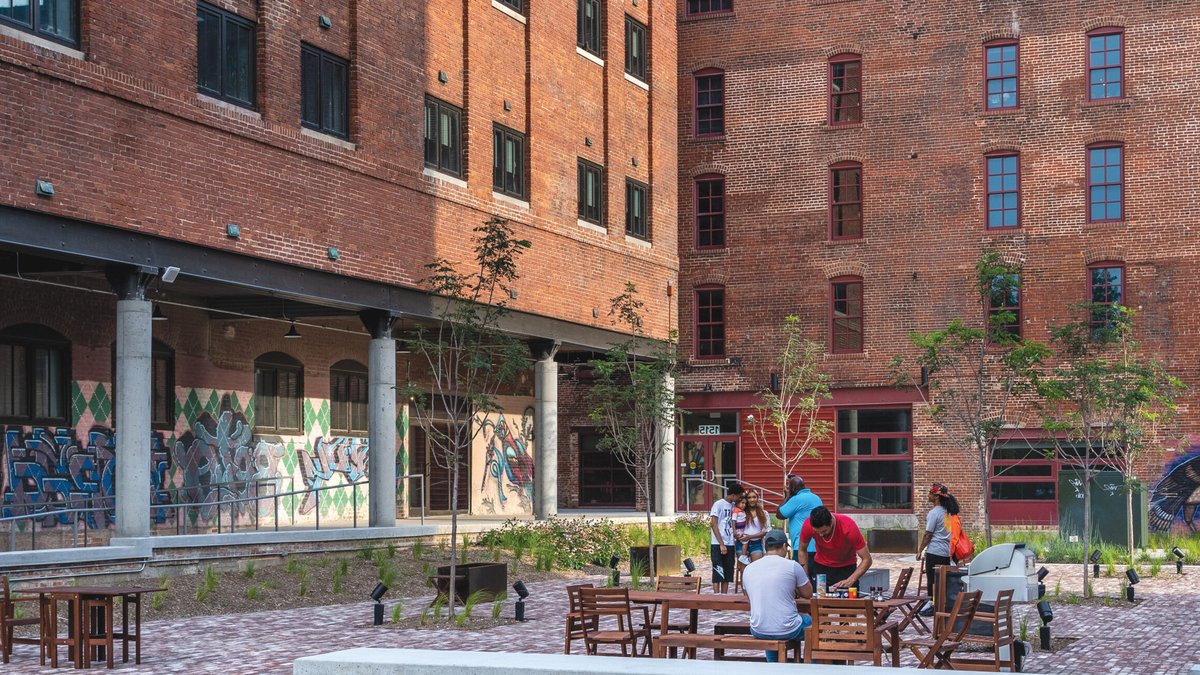
A new nonprofit is reframing old buildings as a climate solution and a cultural one.
Built Buildings Lab started in 2024, founded by architects Billie Faircloth and Lori Ferriss. Both left senior roles—Faircloth as a partner at KieranTimberlake, Ferriss as a principal at Goody Clancy—to focus on transforming existing buildings into humanity’s greatest resource.
The organization has released two reports with the Urban Land Institute, presented research at the 2025 UN Climate Change Conference (COP30), and partnered with the Climate Heritage Network. Its work examines the true value of the buildings already in place.
Between 40% and 50% of U.S. architecture firms’ billings now come from retrofits and renovations. That change reflects a broader reality: globally, renovation rates must increase tenfold to meet Paris Agreement targets.
“Architects won’t necessarily be involved with all those renovations,” Ferriss said. “But we know there’s a climate imperative to use more of what we already have.”
The shift also signals a change in what architecture means. Much of the work involves maintenance, systems upgrades, or care—tasks often seen as separate from traditional design.
Faircloth explained the perspective differently. “There’s still an assumption that when we talk about buildings, we’re talking about new ones. But what can we learn from the ones that already exist?”
Related: Rethinking design for autism support
Historic preservation in the U.S. began in the 1850s with efforts to protect sites tied to prominent figures. By the 1930s, the focus expanded to entire districts, recognizing broader cultural and aesthetic value.
Today, preservation is expanding further. “It’s not just about what’s culturally significant to an elite group,” Ferriss said. “It’s about environmental value, community value—the overlay of many values.”
Built Buildings Lab treats preservation as something that applies to all existing buildings, not just landmarks. Their work in commercial real estate highlights additional benefits. Reports for ULI show that adaptive reuse delivers advantages beyond carbon savings—cultural, economic, and social. Developers often note an intangible appeal: people enjoy being in older structures.
At COP30, the lab brought its message to global climate advocacy. Faircloth described the experience as overwhelming but clarifying. “Built buildings have a seat at the global climate action table,” she said. “When the whole life of buildings—their materials, their assemblies—is recognized as a foundational principle, we have a pathway for systemic change.”
The future of architecture may lie in recognizing the value of what already stands. The challenge is making that value visible to policymakers, developers, and the public.
If the effort succeeds, it could change what it means to build sustainably. The issue isn’t whether more buildings are needed, but how much can be learned from the ones already made.
Older structures often incorporate design elements that blend culture with modern needs. This approach extends to specialized applications, such as creating supportive environments for neurodiverse individuals.