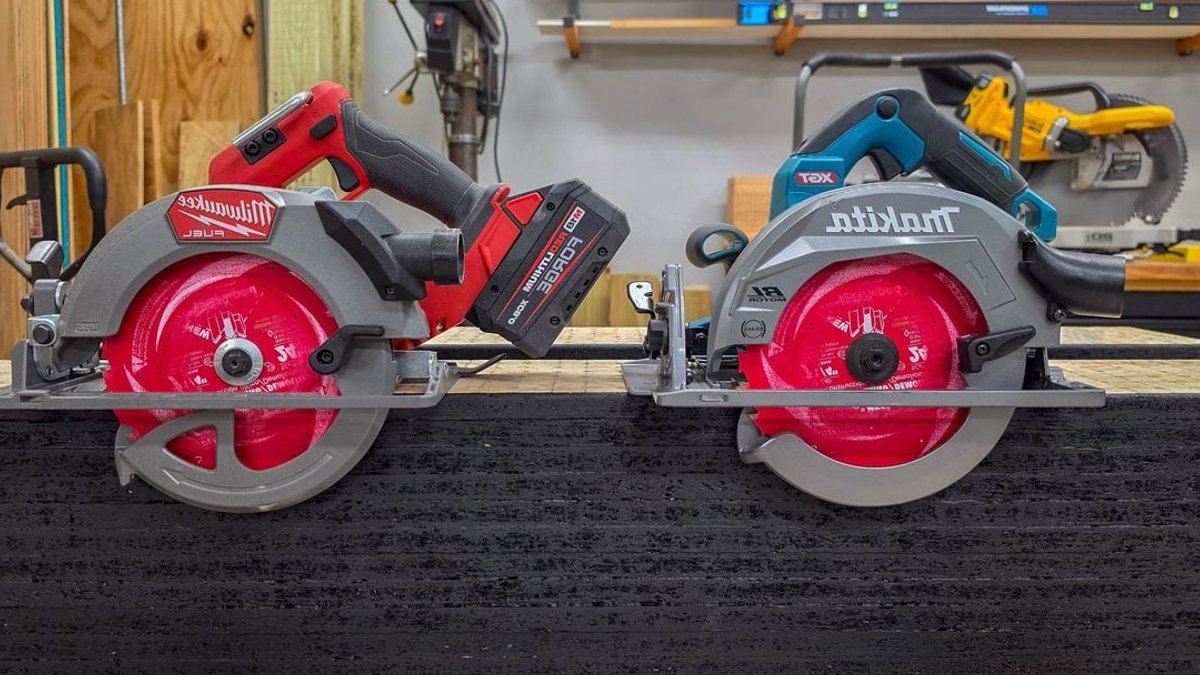
Both Milwaukee and Makita dominate the premium cordless circular saw segment, yet their design philosophies differ significantly. While their top models share identical blade speeds and cutting capacities, a direct comparison was necessary to determine which excels under real-world conditions. The question remained: which brand would emerge victorious in a competitive showdown?
Milwaukee M18 Fuel vs Makita 40V Max Circular Saw
Milwaukee’s 2834 is the latest generation of its M18 Fuel 7-1/4-inch sidewinder-style circular saw. Its brushless motor delivers up to 6,000 RPM, while the saw’s 2 5/8-inch cutting capacity allows it to handle 3X material in a single pass. Milwaukee also increased the maximum bevel angle to 57°, compared to the previous generation, the 2732.
Makita’s GSH01 relies on the 40V max XGT system for power. Its brushless motor also reaches 6,000 RPM and provides a 2 5/8-inch max cutting depth at 90°. The saw bevels up to 56° and includes stops at 22.5° , 45° , and 56° , making it easy to get precise results.
Milwaukee vs Makita Circular Saw: How They Tested
Circular saws make two basic types of cuts: crosscuts and rip cuts. From there, testers added bevel, miter, and compound cuts to see how each saw handles more demanding applications. For testing, they used a variety of 2x materials and OSB subflooring, which helps to minimize some of the variables.
Cutting Performance Under Load
The first thing they wanted to find out was which saw could maintain its cutting performance under load. Both saws have plenty of power for everyday construction work, but testing showed a noticeable difference when they pushed them harder. In a double-stacked 3/4-inch OSB rip cut test, each saw was pulled for 7 feet on a custom sled by a 10-pound weight, and they timed the results. The Milwaukee 2834 finished in 9.76 seconds, while the Makita GSH01 took 13.53 seconds.
A similar outcome occurred during a full-depth rip cut. Milwaukee finished in 17.41 seconds , and Makita took 24.74 seconds —again, losing to its rival, though not by a huge margin.
Makita certainly has enough power, and the GSH01 kept its RPMs steady during these tough cuts. However, when compared side-by-side, Milwaukee was faster in raw cutting speed.
When making basic crosscuts, both saws have ample power to make clean, controlled cuts. The 2834 and GSH01 have the depth and speed to handle standard 2x dimensional lumber with ease. Neither tool gave testers any reason to doubt its ability during standard crosscuts.
Much like standard cross cuts, both saws performed well during miter cuts. The tools tracked smoothly and had enough power to keep blade speed up through the material. Both models got high marks for the lower blade guard action , a common issue with circular saws.
In this case, the guard rose smoothly up and over the edge of the board and didn’t hang up. This led to cleaner and more accurate cuts during testing. Once again, the 2834 and GSH01 are at a stalemate in terms of performance.
Read Also: Curried cod with sweet potato and pea mash recipe
Bevel and Miter Cut Precision
Just like the miter cut tests, both saws handled bevel cuts with ease. The Milwaukee offers a slightly higher maximum bevel angle, while Makita’s three-position stop system makes it quick to move between 22.5°, 45°, and 56°.
One reviewer thinks Milwaukee’s lower guard action is a little smoother than Makita’s based on the design of the leading edge. It’s a small detail, but it made a difference during testing.
Compound cuts are where a circular saw’s overall design starts to matter more. These cuts combine bevel with the rigors of a miter cut, potentially creating a perfect storm for lower blade guard hang-ups.
Fortunately, the Milwaukee 2834 and Makita GSH01 handled compound cuts without issue. Both models delivered excellent sightlines and worked through the demanding 45° compound miter cuts with ease. Much like during standard cross-cut tests, these saws earned top praise from the testing team, and for that, they tip their caps to the design teams.
Shoe friction is one of those small details that becomes more noticeable the more you cut. A smooth shoe takes less effort to push through long cuts. Fortunately, both of these saws feature die-cast magnesium shoes, which help cut down on overall weight and allow them to glide across the workpiece with ease.
Weight and Ergonomics
The Makita GSH01 has the advantage here. It sports a bare tool weight of 8.0 pounds, while the Milwaukee 2834 comes in around 8.43 pounds. With the batteries used in testing, the Makita jumps up to 10.09 pounds compared to 10.81 pounds for Milwaukee. This isn’t too shocking when you look at the Pro category as a whole, but lighter typically leads to lower overall fatigue.
One factor that does make a notable difference is size. The Makita GSH01 is noticeably more compact. It measures 12 1/2 inches long, while Milwaukee stretches to about 14 inches. While it doesn’t make a meaningful difference in performance, Makita’s lower weight and smaller profile make it a more favorable option if storage space is at a premium.
During normal cross cuts and rip cuts, both saws had near-perfect sightlines down to the guide notches on the leading edge of the shoe. Makita’s taller design decreased sight-line quality a little, but Milwaukee’s flatter profile provided an unobstructed view.
Additional Features and Pricing
The Milwaukee M18 Fuel 2835 includes a folding rafter hook for easy storage on 2x material between uses. Its electronic blade brake stops the blade quickly once the trigger is released, enhancing safety. An integrated LED work light and dust blower help maintain a clear, visible cut line during operation. The saw is also One-Key compatible, allowing for better tool tracking within the system. Additionally, it is AWS compatible, enabling remote activation of a paired vacuum or dust extractor via Bluetooth transmitter.
Both saws offer near-perfect sightlines during normal crosscuts and rip cuts, though Milwaukee’s flatter profile provides an unobstructed view compared to Makita’s slightly taller design. Pricing varies, with the Milwaukee 2834 bare tool at $279 and the kit with a 12.0Ah M18 Fuel Forge battery at $499. The Makita GSH01 bare tool is $289, and the kit with a 4.0Ah 40V max XGT battery is $469. The choice between the two depends on the user’s existing battery platform, preferred size, weight, and specific feature needs.