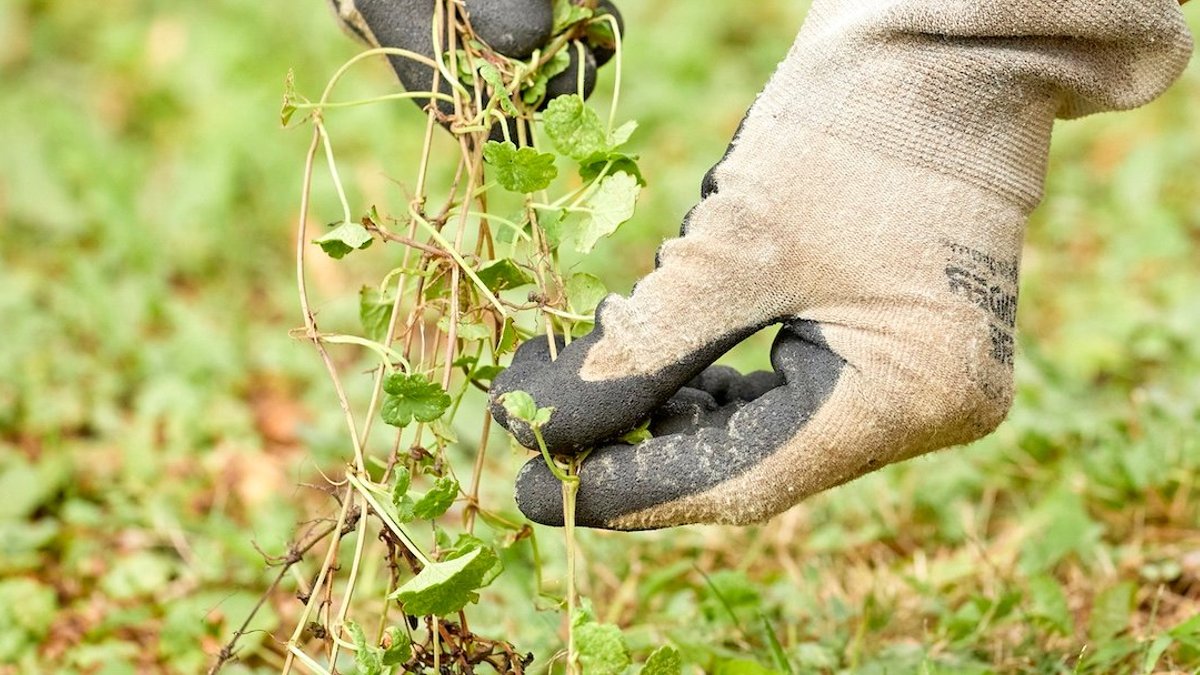
Creeping Charlie, also known as ground ivy, is a persistent weed that can quickly dominate lawns and garden beds, especially in moist, shaded spots where grass struggles to thrive.
Identifying and Removing the Weed
The plant is an evergreen perennial with round, scalloped leaves and small violet‑blue flowers that appear in spring. After flowering, its stems droop and root at intervals, allowing the weed to spread up to two feet from the original plant.
Experts recommend tackling the infestation on a calm day to avoid seed drift or spray blow‑away. Protective clothing such as gloves, long sleeves, and eye protection is advisable because the plant’s oils can cause skin irritation.
Hand‑pulling remains the least disruptive method. If the soil is hard, watering the area first softens it, making it easier to extract the roots. After pulling, it’s important to examine the soil for any remaining root fragments, as even small pieces can regenerate.
For larger patches, smothering the weed under a tarp, cardboard, or several layers of newspaper can be effective. The cover must extend six to twelve inches beyond the visible vines and be weighted down to prevent wind from shifting it. After a week or more, the dead material should be removed and disposed of promptly.
Natural and Organic Options
If mechanical removal does not fully eradicate the weed, many gardeners turn to household solutions. A mixture of two cups white vinegar and one cup warm water can be sprayed onto the foliage on a sunny, wind‑free day. Repeated applications may be necessary because vinegar does not reach the roots.
Some studies suggest that borax may suppress the weed, but the results are inconsistent and the chemical can damage nearby plants. Because boron does not break down quickly, it poses a higher risk to the surrounding garden.
Related: Mushrooms in the lawn: Should I pull them?
Commercial organic contact herbicides, often based on citric acid or citrus oil, provide another alternative. These products should be mixed according to label directions, applied to fully wet leaves, and re‑treated if regrowth appears. While they affect only the above‑ground parts, repeated use is generally safe for soil health.
Homeowners who combine a lawn with occasional organic sprays find it easier to keep the weed at bay. The dense grass competes for light and nutrients, reducing the chance for creeping Charlie to re‑establish.
Chemical Herbicides as a Last Resort
When the infestation is extensive, a targeted chemical may be necessary. Triclopyr‑based products are cited as effective against broadleaf weeds like creeping Charlie, but they must be applied carefully to avoid damage to desirable plants and the environment. Application timing is critical; treating the weed just before or after the first frost, when it’s entering dormancy, improves results.
Safety precautions include wearing gloves, long sleeves, and eye protection, as well as following the manufacturer’s mixing and application instructions precisely. Overuse or incorrect timing can harm turf, non‑target vegetation, and even aquatic ecosystems if runoff occurs.
“The impact on the environment, turf, and wildlife depends on application timing, dosage, and adherence to label instructions,” says a turfgrass professor. He cautions that any herbicide use should be a final step after cultural and mechanical controls have been exhausted.
Preventing future invasions relies on cultural practices. Maintaining a healthy lawn through proper fertilization, mowing at a height of two to three and a half inches, and regular aeration creates a competitive environment that discourages weeds.
Healthy soil resists invasion.