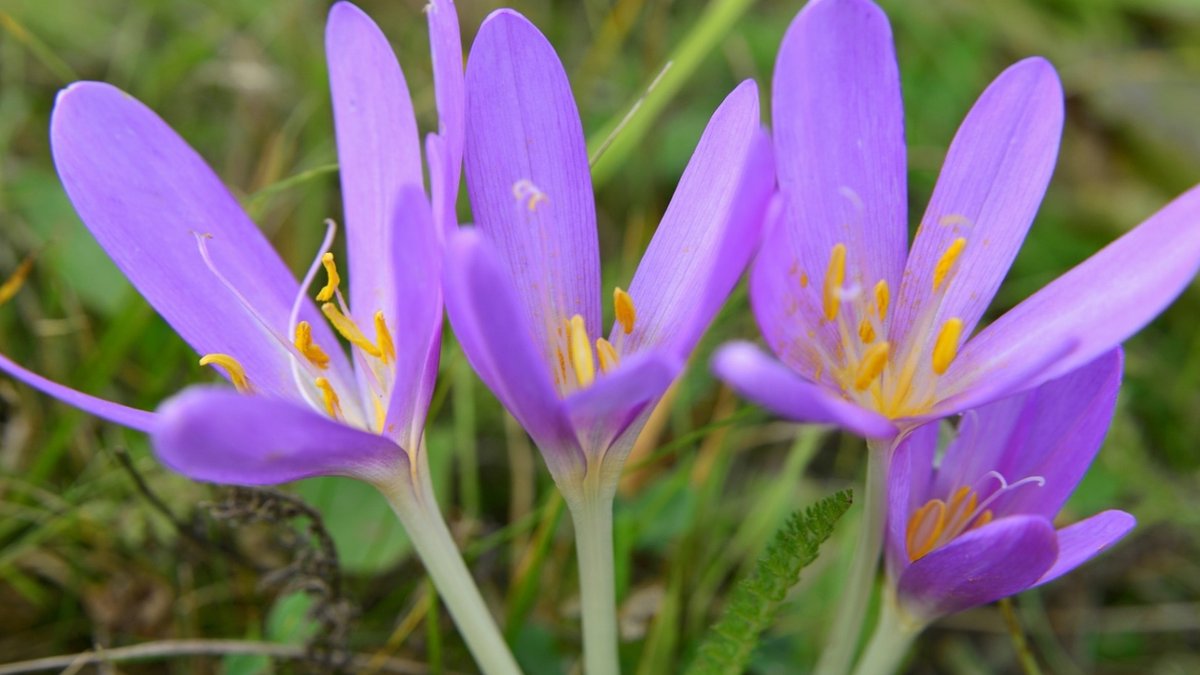
Colchicums, also known as autumn crocus, bring welcome color to gardens after summer has ended. Their delicate pink or white flowers emerge before the leaves appear, adding a touch of elegance to the garden.
These plants have been known by various evocative names, including ‘naked ladies’, ‘naked virgins’, ‘naked boys’, and ‘meadow saffron’. The name ‘colchicum’ derives from Colchis, an ancient region at the eastern end of the Black Sea, where many of these plants are found.
Identifying Colchicums
Colchicums can be confused with autumn-flowering crocuses, but they can be distinguished by the six stamens inside their flowers, compared to the three found in crocus flowers. C. autumnale, the native UK species, was once widespread but was eradicated from meadows due to its toxicity to cattle.
The plant’s toxicity is also deadly to humans, as noted by William Turner in his mid-16th century book A New Herball. Despite this, early herbalists prescribed small doses of colchicine, an alkaloid found in colchicums, to treat gout, a practice that continues today.
Colchicine has also been used in plant breeding to alter chromosome counts and produce polyploidy. However, the plant’s foliage can be a problem, as it emerges early and fades to tan-brown by midsummer, making it stand out in the garden.
Cultivating Colchicums
There are two Plant Heritage National Collections of Colchicums, one at RHS Hyde Hall in Essex and the other at East Ruston Old Vicarage in Norfolk. According to Jeanette Jones, the plant records officer at RHS Hyde Hall, colchicums “seem to thrive in full sun and well-drained areas”.
Alan Gray, of East Ruston Old Vicarage, advises removing spent foliage as soon as it starts to yellow and sowing fast-maturing hardy annuals to reveal the colchicums in all their late-summer glory. C. autumnale has smaller flowers than other species, but it kickstarts the season, often appearing in August.
Related Post: Hudson Valley Lighting Unveils UK Autumn Collection
For larger, goblet-shaped flowers, C. speciosum ‘Album’ is a good choice, with pure-white, weather-resistant blooms that flower at the end of September. It’s essential to order the correct variety, as some species have similar names, such as C. speciosum ‘Atrorubens’, which has the darkest pink goblet-shaped flowers.
Colchicums can be planted in drifts and groups to create an autumn feature, and they do well in well-drained soil that isn’t too acidic. The planting depth depends on the size of the corm, with larger ones planted up to 12.5cm deep.
Colchicums with smaller corms are fussier about drainage and require lots of sun. The foliage can be tidied and cut off once it’s almost brown, allowing the plant to transfer nutrients back into the bulbs.
Dividing colchicums should be done in midsummer, straight after the foliage has faded but before the flowers arrive. Slugs and snails can be a problem, so using a preferred method of control is necessary. Seed capsules ripen in early summer, and hybrids do occur, allowing for the collection of seed and sowing as soon as possible.
Seedlings appear by midwinter, and with proper care, colchicums can thrive and provide a beautiful display of color in the autumn. C. cilicicum ‘Purprureum’ has a tight mass of flowers in purple-pink that open wide for maximum appeal, making it a great choice for gardeners looking to add some autumn color.
The rich purple-pink flowers of ‘Glory of Threave’ have a beautiful silvery sheen, making it a highly sought-after variety.